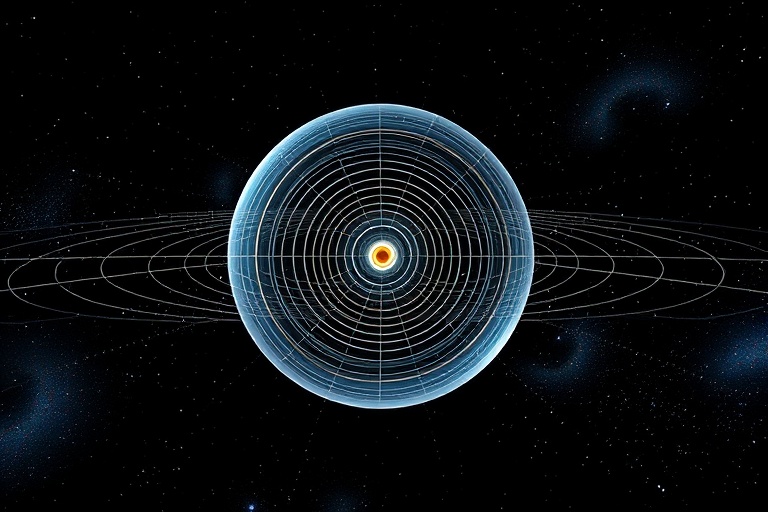
Special Relativity was proposed by Albert Einstein in 1905 to explore the relativity of uniform motion and has two postulates.
The first postulate states that absolute motion cannot be detected and the laws of physics are the same in all inertial reference frames. This can also be stated as the motion of an object only exists if it's observed relative to another object.
The second postulate states the speed of light is measured to be the same in all inertial reference frames.
Special Relativity can be stated simply as ripples in a pond viewed as circular by an observer in a stationary inertial reference frame must also viewed as circular by an observer in an inertial reference frame moving at a uniform velocity and all the physical effects of relativity are the result of that equivalence.
GENERAL RELATIVITY
⚜ What is General Relativity? ⚜
General Relativity was proposed by Albert Einstein in 1916 and explores the relativity of non-uniform motion.
General Relativity postulates that gravity is the curvature of space itself.
The principle feature of General Relativity is the Principle of Equivalence, which states the difference between a uniform gravitational field and a uniform acceleration cannot be detected.
TRIVIA
🔔 QUESTION : The work of which scientist inspired Einstein to develop the theory of Relativity?
💡 Hover or Tap for the ANSWER! 💡
Einstien was inspired by the work of Hendrik Lorentz when he developed Relativity. Lorentz had also previously developed the Lorentz Transformations, which are a major part of Relativity.
INERTIAL REFERENCE FRAME
⚜ What is an Inertial Reference Frame? ⚜
An Inertial Reference Frame is a reference frame where Newton's Laws of motion are valid, such as uniform motion in a straight line.
NON-INERTIAL REFERENCE FRAME
⚜ What is a Non-Inertial Reference Frame? ⚜
A Non-Inertial Reference Frame is a reference frame of non-uniform motion where Newton's Laws of motion cannot apply.
Objects on the surface of the Earth are in a Non-Inertial Reference Frame because the Earth is rotating.
CORIOLIS FORCE
⚜ What is the Coriolis Force? ⚜
The Coriolis Force is an example of a fictitious additional force resulting from the rotating Earth being in a Non-Inertial accelerating reference frame.
The Coriolis Force is also an example of General Relativity as an observer on the Earth's surface cannot detect that they are rotating with the Earth.
MICHELSON-MORLEY EXPERIMENT
⚜ What is the Michelson-Morley Experiment? ⚜
The Michelson-Morley experiment was an experiment performed to measure the speed of light relative to the Ether.
The result of the experiment was null, indicating the speed of light was independent of its speed relative to the Ether, unlike the speed of sound waves in air.
FRACTAL VIDEO
Click the Image below to watch Fractal Time Tunnel.
THE ETHER
⚜ What is the Ether? ⚜
The Ether was considered the medium of the vacuum of outer space of which light was believed to need to propagate, but it has been proven the Ether need not exist.
The Ether is the equivalent to air being a medium for the propagation of sound waves.
GALILEAN TRANSFORMATION
⚜ What is the Galilean Transformation? ⚜
The transformation of coordinates from one reference frame to another are invariant with a Galilean Transformation, which means that Newton's laws behave the same in both reference frames.
LORENTZ TRANSFORMATION
⚜ What is the Lorentz Transformation? ⚜
The Lorentz Transformation is an adaption of the Galilean Transformation that adds an additional factor to allow the laws of physics to be invariant between different inertial frames of reference.
The Lorentz Transformation arose from the need for a spherical wavefront to remain spherical even when the reference frame was moving.